




PCOS, Insulin Resistance and Prediabetes: Why Strength, Nutrition and Sustainable Habits Matter
By Jasmit Kohli
A diagnosis of PCOS or prediabetes can feel like a warning about the future—but it does not have to become a definition of your future.
For many women, the conversation around PCOS quickly becomes focused on periods, weight gain, acne, unwanted hair growth or fertility. But there is another important part of the picture that deserves attention: metabolic health.
PCOS is associated with an increased risk of insulin resistance and abnormal glucose regulation. The relationship is complex, and not every woman with PCOS has insulin resistance, but metabolic risk is important enough that current guidelines recommend appropriate assessment and ongoing attention to lifestyle and cardiometabolic health. (Monash University)
When PCOS and prediabetes occur together, the answer is not an extreme diet, endless cardio or a race to lose weight as quickly as possible.
The more useful question is:
How can we make the body metabolically healthier—and build habits that can actually be maintained?
What Exactly Is Insulin Resistance?
To understand PCOS and prediabetes, it helps to understand insulin.
Insulin is a hormone that helps move glucose from the bloodstream into cells, where it can be used for energy.
With insulin resistance, muscle, liver and other tissues become less responsive to insulin. The body may compensate by producing more insulin to maintain relatively normal blood glucose levels.
Over time, however, the pancreas may struggle to compensate adequately. Blood glucose can begin to rise, potentially progressing from normal glucose regulation to prediabetes and eventually type 2 diabetes in susceptible individuals.
Prediabetes is generally defined by an A1C of 5.7–6.4%, fasting plasma glucose of 100–125 mg/dL, or a 2-hour glucose value during a 75-g oral glucose tolerance test of 140–199 mg/dL. (Diabetes Journals)
This is why prediabetes should not simply be dismissed as “slightly high sugar.”
It is an opportunity to intervene.
Why Does Insulin Resistance Matter in PCOS?
PCOS is a reproductive, endocrine and metabolic condition. Insulin resistance is one of the important physiological factors associated with PCOS, although its presence and severity vary between individuals.
Higher insulin levels can interact with ovarian hormone production and may contribute to increased androgen activity in some women. At the same time, excess adiposity—particularly central adiposity—can further worsen metabolic dysfunction.
This creates a complicated relationship:
PCOS → metabolic dysfunction → hormonal consequences
while factors such as excess body fat and physical inactivity can further influence the cycle.
Importantly, this does not mean that every woman with PCOS needs to lose weight.
The 2023 International Evidence-Based Guideline for PCOS emphasizes that healthy lifestyle interventions can improve metabolic health and quality of life even when significant weight loss does not occur. (Monash University)
That distinction matters.
Strength Training Is More Than a Way to “Tone”
One of the most valuable tools for improving metabolic health is often sitting right in the gym:
muscle.
Skeletal muscle is a major site of glucose disposal. When you contract your muscles during exercise, glucose uptake can increase through mechanisms that are partly independent of insulin.
Regular resistance training can therefore become an important component of a strategy aimed at improving glucose regulation and insulin sensitivity.
This is one reason I believe women with PCOS should not be encouraged to fear strength training.
Lifting weights does not automatically mean becoming “bulky.”
It means building stronger, more metabolically active tissue.
A well-designed program might include movements such as:
Lower-Body Strength
- Squats or squat variations
- Lunges
- Step-ups
- Hip hinges
- Romanian deadlifts
- Glute bridges or hip thrusts
Upper-Body Strength
- Rows
- Lat pulldowns
- Chest presses
- Shoulder presses
- Push-up variations
Core and Functional Strength
- Carries
- Planks
- Dead bugs
- Controlled anti-rotation exercises
The exact exercises, intensity and volume should be individualized according to fitness level, injuries, preferences and medical circumstances.
But You Don’t Need to Live in the Gym
Exercise does not have to mean a two-hour workout.
For someone beginning their journey, consistency is more valuable than an impressive-looking program that lasts three weeks.
A combination of:
strength training + walking + regular daily movement
can be far more realistic.
The American Diabetes Association’s 2026 Standards of Care recommend at least 150 minutes per week of moderate-intensity physical activity for adults at high risk of type 2 diabetes, alongside lifestyle intervention and weight-management strategies when appropriate. Resistance training can also be incorporated. (Diabetes Journals)
And there is another simple strategy that is often overlooked:
Break up prolonged sitting.
Even small periods of movement throughout the day can contribute to better glucose management.
Your workout matters.
But what you do during the other 23 hours matters too.
Nutrition: Don’t Fear Carbohydrates—Understand Them
One of the first things many women hear after being told they have insulin resistance is:
“Stop eating carbs.”
That’s an oversimplification.
Carbohydrates are not inherently harmful. The bigger picture includes the type, quantity, fiber content, overall dietary pattern, protein intake, total energy intake and individual metabolic response.
A more sustainable approach generally emphasizes nutrient-dense foods such as:
- Vegetables
- Whole fruits
- Legumes
- Whole grains
- Nuts and seeds
- Lean protein sources
- Low-fat dairy or suitable alternatives
while reducing frequent intake of sugar-sweetened beverages, highly refined grains, sweets and heavily processed foods. These principles are consistent with the ADA’s 2026 recommendations for people with prediabetes and diabetes. (Diabetes Journals)
Instead of asking:
“Which food will cure insulin resistance?”
ask:
“What eating pattern can I follow consistently while meeting my nutritional needs?”
That’s a much better question.
Protein Matters—But It Isn’t a Magic Fix
Adequate protein can help support muscle maintenance and growth, particularly when someone is strength training or losing body fat.
Protein also contributes to satiety, making it easier for some people to maintain an appropriate calorie intake.
But more protein is not automatically better.
Nutrition should be individualized around body size, activity, dietary preferences, medical conditions and overall nutritional adequacy. The ADA also emphasizes monitoring nutritional adequacy—including protein and micronutrient intake—during intentional weight loss. (Diabetes Journals)
The goal is not to build a diet around one nutrient.
It is to build a balanced dietary pattern.
Sustainable Fat Loss vs. Crash Dieting
For women with PCOS who have overweight or obesity, modest fat loss can improve several metabolic outcomes.
But there is a major difference between:
losing weight quickly
and
improving health sustainably.
The 2026 ADA Standards recommend lifestyle programs targeting at least 5–7% weight reduction for adults with overweight or obesity who are at high risk for type 2 diabetes, together with healthy eating and physical activity. (Diabetes Journals)
That does not mean every woman with PCOS should pursue the same percentage of weight loss.
Someone who is already at a healthy weight may have completely different goals.
For some women, the most meaningful outcomes may be:
- Better glucose regulation
- Improved fitness
- Increased strength
- Improved waist circumference
- Better lipid profile
- More daily energy
- Better sleep
- Improved confidence
- Maintaining a healthy weight rather than losing more
Health is bigger than the number on the weighing scale.
Sleep Is Part of the Metabolic Equation
Sleep is often treated as something that can be sacrificed when life becomes busy.
But recovery is not optional.
Poor sleep can influence appetite regulation, food choices, energy levels, stress and metabolic health. For someone already working on insulin sensitivity and sustainable fat loss, consistently inadequate sleep can make the entire process harder.
So the program cannot simply be:
Diet + exercise = success.
It needs to become:
Nutrition + strength + movement + sleep + recovery + consistency.
That is the lifestyle equation.
The Goal Is Not to “Beat PCOS”
PCOS is not a personal failure.
And having prediabetes is not a character flaw.
These conditions are influenced by biology, genetics, environment, lifestyle and other factors. Blaming yourself rarely produces better health outcomes.
Instead, focus on the variables you can influence.
You can improve your strength.
You can increase your daily movement.
You can build a more balanced diet.
You can improve your sleep routine.
You can work toward a healthier body composition if appropriate for you.
And you can work with qualified healthcare professionals to monitor your metabolic health.
Your Diagnosis Is Information—Not Your Identity
A diagnosis should start a conversation, not end it.
PCOS may increase metabolic risk. Prediabetes may indicate that your glucose regulation needs attention. But both can also become a reason to take your health more seriously—not a reason to give up.
The evidence supports lifestyle intervention as a core component of PCOS management, while diabetes-prevention guidelines emphasize physical activity, healthy eating and appropriate weight management for people at elevated metabolic risk. (Monash University)
And perhaps the most important message is this:
You don’t need a perfect routine.
You need a routine you can repeat.
One workout.
One balanced meal.
One walk.
One better night’s sleep.
One healthier choice.
Then another.
And another.
Because metabolic health isn’t built in a week.
It is built through the small decisions you are willing to repeat for years.
A Note From Jasmit Kohli
If you’ve been diagnosed with PCOS, insulin resistance or prediabetes, don’t rely on social-media advice alone. Your medical history, laboratory results, medications, reproductive goals and individual nutritional needs matter.
A qualified physician or registered dietitian can help assess your metabolic risk and determine whether further testing or treatment is appropriate.
Fitness coaching can support your exercise, nutrition habits and behaviour change—but it should complement, not replace, appropriate medical care.
Your diagnosis is part of your health story. It doesn’t have to be the ending.
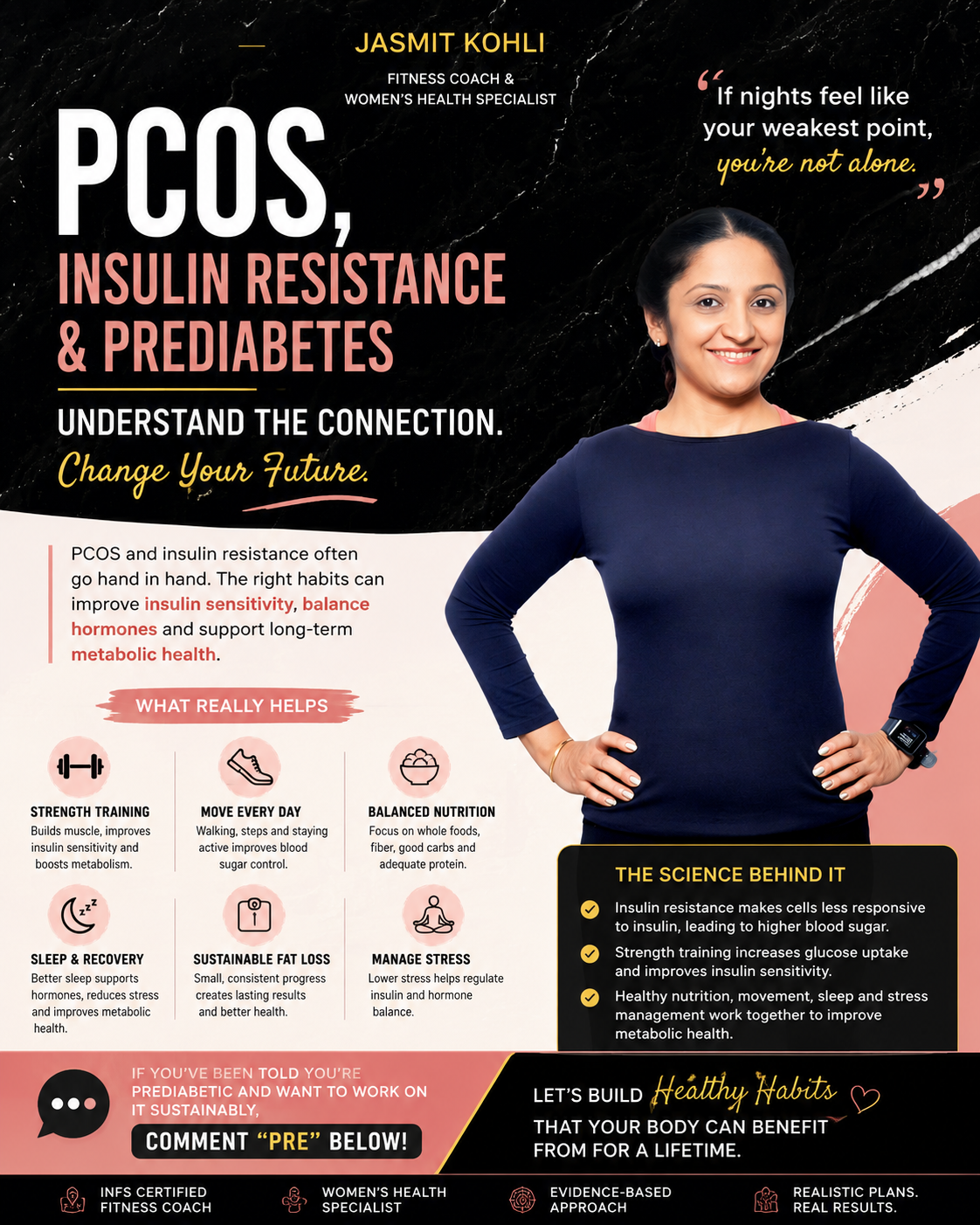
If you’ve been told you’re prediabetic and want to start working toward better metabolic health sustainably, comment “PRE” below. 💬
Keywords
PCOS, insulin resistance, prediabetes, PCOS weight loss, PCOS diet, PCOS workout, strength training for PCOS, PCOD, fat loss for women, women’s fitness, insulin sensitivity, metabolic health