




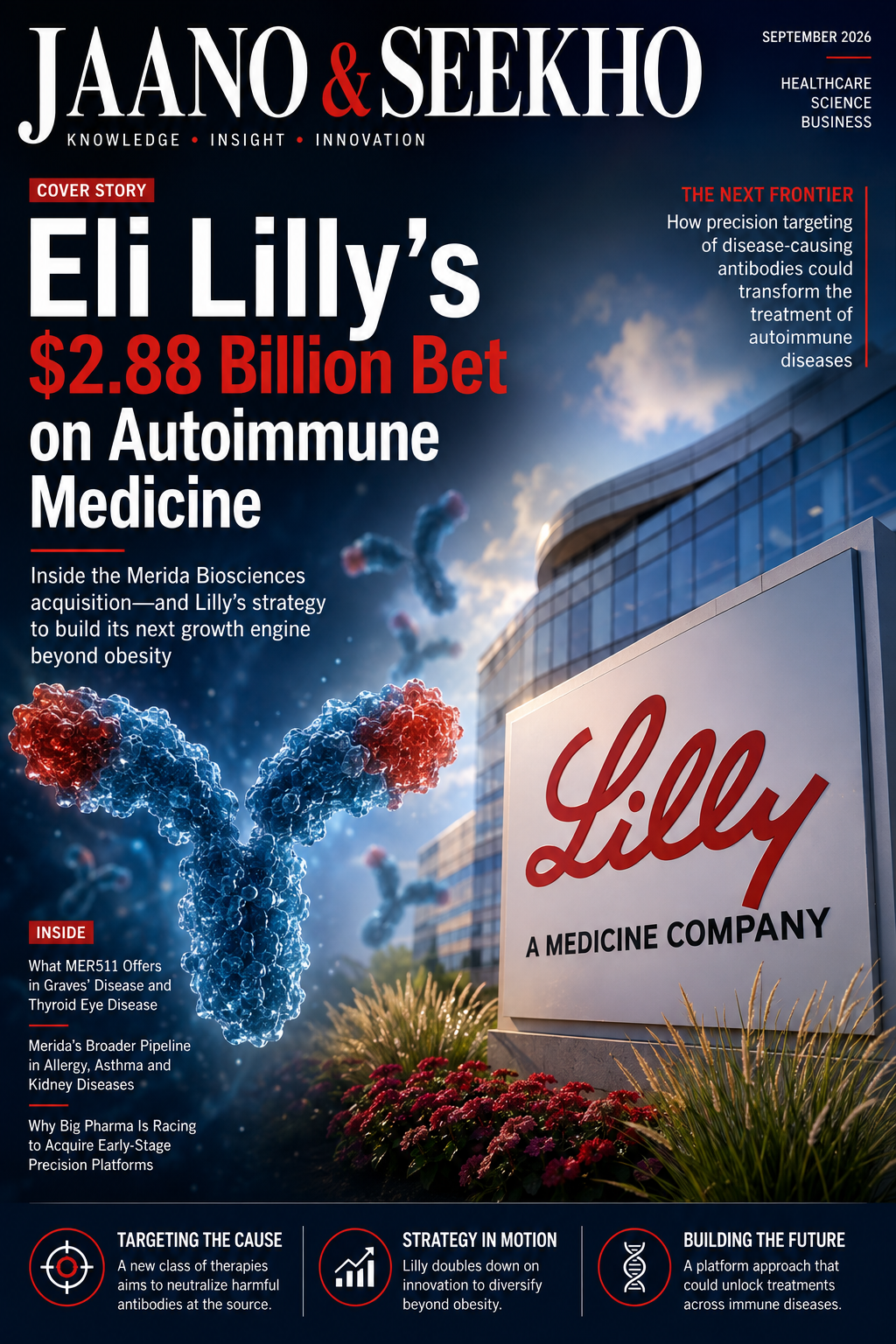
Eli Lilly’s $2.88 Billion Bet on Autoimmune Medicine
Inside the Merida Biosciences acquisition—and Lilly’s strategy to build its next growth engine beyond obesity
By Jaano & Seekho Editorial Desk
September 2026
A New Chapter Beyond Obesity
For much of the pharmaceutical industry, few stories have been as transformative as Eli Lilly’s rise through the extraordinary success of its obesity and diabetes medicines.
But the next chapter of Lilly’s growth strategy may have little to do with weight loss.
On August 31, 2026, Eli Lilly and Company announced plans to acquire privately held Merida Biosciences in a transaction valued at up to $2.88 billion in cash.
The deal gives Lilly access to Merida’s emerging portfolio of precision therapeutics designed to selectively target disease-causing antibodies—most notably MER511, an experimental medicine being developed for autoimmune thyroid disorders.
The transaction is more than a pipeline acquisition. It signals a broader strategic ambition: to use the financial strength generated by Lilly’s obesity and diabetes franchise to build a diversified pharmaceutical portfolio capable of sustaining growth across multiple therapeutic areas.
The Asset at the Centre of the Deal
At the heart of the acquisition is MER511, Merida’s lead drug candidate.
The experimental therapy is being developed for autoimmune diseases including Graves’ disease and thyroid eye disease (TED).
Both conditions originate from abnormal immune activity.
In Graves’ disease, the immune system produces antibodies that stimulate the thyroid gland, causing it to become overactive and produce excessive thyroid hormones.
Thyroid eye disease is a related autoimmune condition in which inflammation can affect tissues around the eyes, potentially causing eye bulging, double vision and, in severe cases, impaired vision.
For patients, these conditions can extend far beyond an abnormal laboratory result. They can affect appearance, vision, daily functioning and quality of life.
That makes the search for therapies that intervene earlier in the disease mechanism particularly important.
From Treating Consequences to Targeting the Cause
Merida’s scientific proposition is built around what could become an increasingly important direction in autoimmune drug development: selectively eliminating or reducing the antibodies that drive disease.
Rather than simply managing the downstream consequences of autoimmune activity, the company’s approach aims to intervene closer to the biological mechanism responsible for the disease.
According to Lilly, early data for MER511 showed a substantial reduction in thyroid-stimulating antibodies associated with Graves’ disease and thyroid eye disease, alongside an initially favorable safety profile.
The qualification is important.
MER511 remains an early-stage experimental therapy. Early clinical findings can be encouraging, but they do not guarantee that a medicine will ultimately demonstrate sufficient efficacy, safety or durability in larger clinical trials.
For Lilly, however, the potential upside is significant.
If the mechanism translates successfully into later-stage studies, the technology could represent a differentiated approach to autoimmune medicine.
Why Lilly Is Looking Beyond Obesity
The acquisition comes at an important moment for Lilly.
The company’s obesity and diabetes portfolio has generated enormous commercial momentum, helping transform the competitive landscape of metabolic medicine.
But blockbuster franchises eventually face competitive pressure.
Rival medicines, new mechanisms, pricing dynamics, patent considerations and changing treatment paradigms can all influence long-term growth.
For a pharmaceutical company of Lilly’s scale, the strategic response is straightforward:
Invest today’s success into tomorrow’s pipeline.
The Merida transaction fits precisely within that philosophy.
Lilly has been pursuing acquisitions at an accelerated pace in 2026, using its growing financial resources to expand into therapeutic areas beyond obesity and diabetes.
Analysts have interpreted the Merida acquisition as further evidence of management’s intention to diversify the company’s future pipeline.
A Different Kind of Pharmaceutical Bet
At first glance, $2.88 billion may appear enormous for an early-stage biotechnology company.
But the structure of the transaction provides important context.
Lilly said the agreement includes an upfront payment as well as additional payments linked to the achievement of specified milestones. The company did not disclose the detailed financial terms.
That structure effectively creates a risk-sharing mechanism.
Lilly gains access to potentially valuable science while some of the total consideration remains dependent on future development achievements.
For biotechnology investors and pharmaceutical strategists, such deals illustrate a broader industry trend: large pharmaceutical companies are increasingly willing to acquire innovative platforms and early-stage assets before they reach commercial maturity.
The attraction is obvious.
Buying early can provide access to differentiated science before a competing pharmaceutical company does.
The trade-off is equally obvious.
The buyer assumes substantial clinical and development risk.
The Competitive Landscape
The thyroid disease market is already commercially established, but it is far from static.
Treatment options for Graves’ disease currently include:
- Antithyroid medicines
- Radioactive iodine
- Surgery
Thyroid eye disease has also attracted significant pharmaceutical investment.
Two FDA-approved therapies highlighted in the supplied report are Tepezza, developed by Amgen, and Lumvoa, developed by Viridian Therapeutics.
This competitive landscape means MER511 will not enter an empty market.
Its opportunity will depend on whether it can demonstrate meaningful differentiation—whether through efficacy, safety, durability, convenience, patient selection or its ability to address disease biology in a fundamentally different way.
Merida’s Pipeline Extends Beyond Thyroid Disease
The strategic appeal of Merida may also lie in what comes after MER511.
The company’s pipeline includes MER769, an experimental therapy being investigated for food allergy, asthma and other allergic diseases.
Merida also has earlier-stage programs targeting kidney and other immune-mediated conditions.
This gives Lilly something potentially more valuable than a single drug candidate:
a platform for building an autoimmune and immunology franchise.
If the underlying precision-therapeutic approach proves successful, Lilly could potentially expand the technology across multiple antibody-driven diseases.
That possibility helps explain why an early-stage biotechnology company can become strategically important to a global pharmaceutical company.
The Bigger Industry Story
The Merida acquisition reflects a larger transformation occurring across the pharmaceutical industry.
The most valuable medicines of the next decade may not necessarily come from traditional broad-spectrum approaches.
Increasingly, drug developers are looking for ways to identify:
Which biological molecule is driving the disease?
Which patient is most likely to respond?
Can that disease-causing mechanism be selectively neutralized?
This is the logic behind precision medicine.
In autoimmune disease, the challenge is especially complex because the immune system itself is not the enemy.
It is an essential part of human biology.
The goal is therefore not simply to suppress immunity indiscriminately, but to intervene with greater precision.
If successful, such approaches could potentially deliver meaningful disease control while reducing unnecessary effects on healthy immune function.
What the Deal Says About Lilly
The acquisition also provides an insight into how Lilly sees itself evolving.
The company is no longer simply positioning itself around diabetes and obesity.
It is building a broader portfolio spanning metabolic disease, immunology and other high-value areas of medicine.
That diversification matters.
A pharmaceutical company’s long-term strength depends not only on the performance of today’s blockbuster products, but on whether it can repeatedly replace and expand its revenue base through scientific innovation.
For Lilly, the question is therefore not simply whether MER511 succeeds.
The larger question is whether acquisitions such as Merida can help create the next generation of Lilly medicines.
The Road Ahead
Lilly expects the Merida transaction to close in the fourth quarter of 2026, subject to customary closing conditions.
Following completion, attention will shift from the transaction itself to clinical development.
MER511 will need to progress through increasingly rigorous clinical testing.
Researchers and regulators will ultimately need answers to the questions that matter most:
- Does the treatment produce meaningful clinical benefits?
- Are the reductions in disease-associated antibodies durable?
- How does its safety profile compare with existing treatments?
- Which patients benefit most?
- Can the therapy alter the course of autoimmune disease rather than simply control symptoms?
- Can the underlying approach be extended to other immune-mediated diseases?
Those answers will determine whether Merida becomes a successful acquisition—or an expensive scientific experiment.
The Strategic Takeaway
The $2.88 billion headline is only one part of the story.
The more important development is what Lilly is trying to build with its capital.
The company’s obesity franchise has created enormous financial momentum. Now, Lilly is attempting to convert that momentum into a broader innovation engine.
Merida offers a particularly interesting opportunity because its science sits at the intersection of precision medicine, immunology and antibody-driven disease.
MER511 is still an experimental asset, and considerable clinical risk remains.
But if the science works, the potential extends beyond Graves’ disease and thyroid eye disease.
It could open the door to a new generation of highly targeted therapies for diseases in which harmful antibodies play a central role.
That is ultimately what makes the transaction significant.
Lilly is not simply buying a drug candidate. It is placing a strategic bet on the future of precision immunology.
And in an industry increasingly defined by scientific differentiation, that may prove to be the most important part of the deal.
AT A GLANCE
| Deal | Eli Lilly acquisition of Merida Biosciences |
|---|---|
| Transaction value | Up to $2.88 billion |
| Consideration | Upfront payment + milestone-based payments |
| Expected closing | Fourth quarter 2026 |
| Lead asset | MER511 |
| Key indications | Graves’ disease & thyroid eye disease |
| Therapeutic focus | Precision targeting of disease-causing antibodies |
| Additional pipeline | MER769 and earlier-stage immune-mediated disease programs |
| Strategic objective | Expand Lilly’s pipeline beyond obesity and diabetes |
EDITOR’S NOTE
The information in this feature is based on the Reuters report supplied for publication and company statements cited within that report. MER511 remains an investigational medicine; early-stage clinical results should not be interpreted as evidence of established efficacy or regulatory approval.
Jaano & Seekho | Healthcare • Science • Business
Where scientific innovation meets the business of medicine.