




When Your Periods Start Coming Back: What Exercise, Fat Loss and Metabolic Health Can Really Mean
By Sohamjita Roy
Fitness & Women’s Health | Evidence-Informed Perspective
A Period Can Be More Than a Monthly Event
You start exercising consistently. Your meals become more balanced. Your body composition begins to change. Perhaps you lose some excess body fat—and then something unexpected happens.
Your period, which had been irregular for months, begins appearing more predictably.
For women living with polycystic ovary syndrome (PCOS), this can sometimes be an encouraging sign that metabolic and reproductive function are changing in a positive direction.
But there is an important distinction between what science supports and what social media often promises.
There is no universal timeline that says, “Lose this much fat and your periods will become regular in exactly eight weeks.”
The relationship between exercise, body composition, insulin sensitivity, ovulation and menstrual cycles is considerably more complex.
And that complexity is precisely why progress should be measured by more than the number on the weighing scale.
The Metabolic Connection Behind the Menstrual Cycle
PCOS is a complex endocrine and metabolic condition associated with menstrual irregularity, ovulatory dysfunction, hyperandrogenism and increased cardiometabolic risk.
Insulin resistance is common in PCOS, although it does not affect every woman in exactly the same way.
When insulin sensitivity improves, the body can regulate glucose and insulin more effectively. In some women with PCOS, improvements in metabolic health can be accompanied by improvements in ovarian function and ovulation.
Lifestyle intervention—including physical activity, nutrition and sustainable weight management—is therefore considered a core component of PCOS management in international evidence-based guidelines. (Monash University)
The key word is sustainable.
The goal isn’t simply to become smaller.
The goal is to become metabolically healthier while preserving adequate nutrition, muscle mass, energy availability and overall wellbeing.
Does Losing Body Fat Make Periods Regular?
Sometimes—but the science needs a more precise explanation.
Research has reported that modest weight loss can improve ovulation and menstrual regularity in some women with PCOS. Reviews have described reproductive improvements with approximately 2–5% reductions in total body weight in some lifestyle interventions, while reductions of more than 5% have also been associated with reproductive and metabolic benefits. (PubMed Central (PMC))
This is different from saying that every woman needs to lose a particular percentage of body-fat percentage.
The evidence is stronger for modest body-weight reduction than for a universal “5–7% body-fat reduction” threshold.
And even a 5% change should never be interpreted as a guarantee.
Individual responses vary.
Some women experience improvements with relatively modest changes. Others may see little menstrual improvement despite significant changes in body weight or composition.
That is one reason PCOS should never be reduced to a simple “eat less and lose weight” equation.
Exercise Can Help Even When the Scale Barely Moves
Perhaps one of the most important messages for women beginning their fitness journey is this:
Exercise does not need to produce dramatic weight loss to be beneficial.
Studies in women with PCOS have found improvements in insulin sensitivity and cardiometabolic health following exercise even when body weight did not significantly change. One study reported improved insulin sensitivity following aerobic exercise independently of changes in body weight and adiposity. (PubMed Central (PMC))
That means a woman can be making meaningful physiological progress even when her weighing scale appears stubborn.
Strength training, aerobic activity, improved cardiorespiratory fitness, better dietary quality and increased daily movement can all form part of a sustainable lifestyle approach.
The scale is only one measurement.
It is not a metabolic-health report card.
So, How Quickly Can Periods Become Regular?
This is where caution matters.
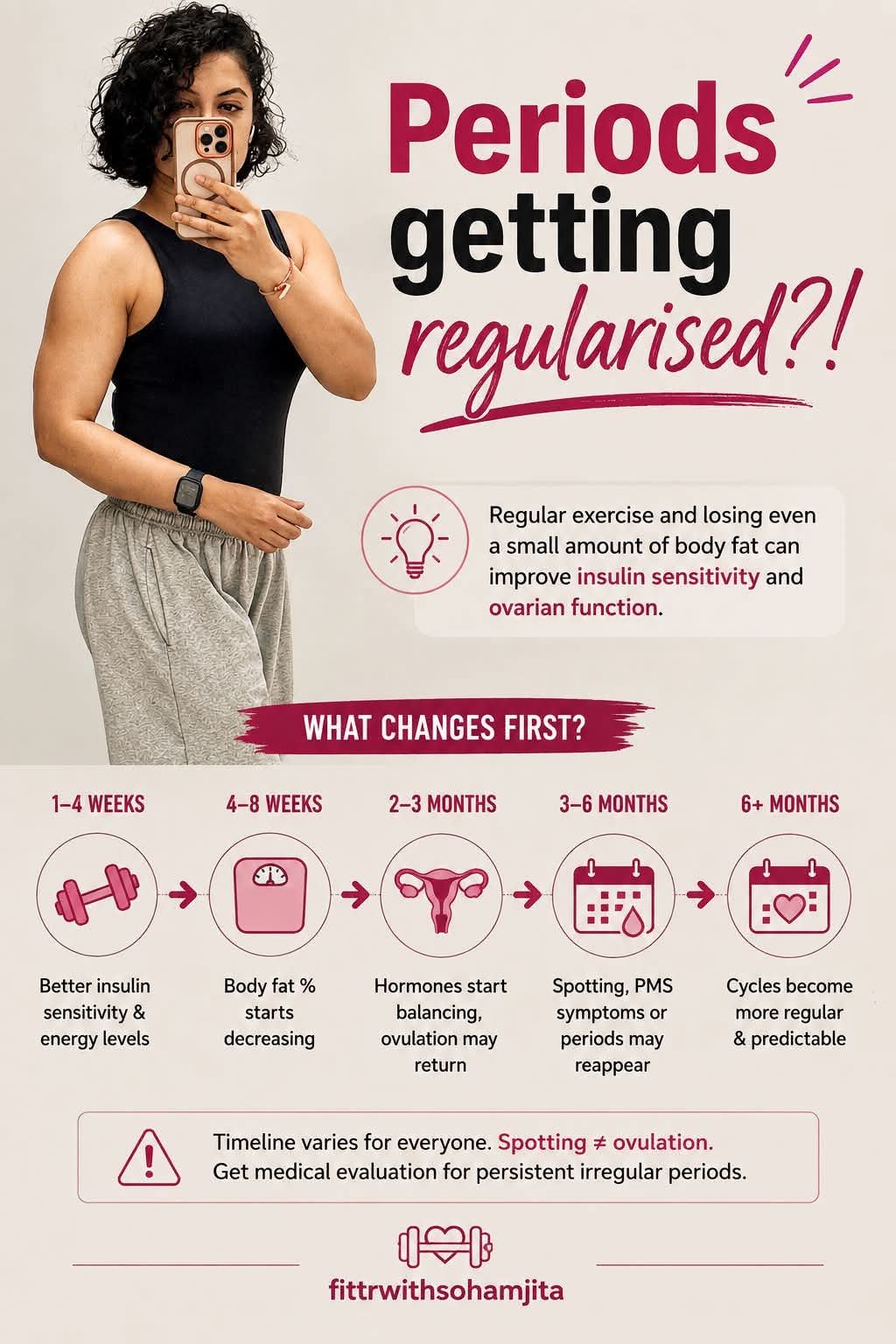
There is no scientifically valid universal timeline such as:
“1–4 weeks: insulin improves.”
“4–8 weeks: fat decreases.”
“2–3 months: ovulation returns.”
“6 months: periods become regular.”
Those timelines can be useful as an illustrative framework for discussing gradual change, but they should not be presented as a predictable biological sequence for every woman.
Some women may notice changes within a few months.
For others, it may take considerably longer.
And for some, lifestyle changes alone may not restore regular ovulation.
The 2023 International Evidence-Based PCOS Guideline specifically recognises that irregular menstrual cycles and ovulatory dysfunction can occur in PCOS, and importantly, a regular-looking cycle does not necessarily prove that ovulation has occurred. (Monash University)
A Regular Period Does Not Automatically Mean Ovulation
This distinction deserves more attention.
Menstruation ≠ proof of ovulation
Bleeding can occur without normal ovulation.
Therefore, if fertility or ovulatory function is a concern, simply observing that periods have become more frequent may not provide the complete picture.
The 2023 guideline notes that ovulatory dysfunction can still occur despite apparently regular cycles; when confirmation is clinically necessary, ovulation can be assessed using appropriate medical evaluation, including progesterone measurement. (Monash University)
This is why the statement:
“My periods came back, so I must be ovulating normally.”
is not always medically accurate.
What About Spotting?
Spotting ≠ Ovulation
Unexpected spotting can occur for many reasons.
It should not automatically be interpreted as evidence that ovarian function has “restarted.”
If bleeding remains irregular, unusually frequent, unusually heavy, prolonged, or otherwise concerning, medical evaluation is appropriate.
Menstrual changes can be influenced by much more than body weight.
Not Every Irregular Period Is About Weight
This is perhaps the most important caveat.
PCOS is one possible explanation for irregular cycles—but it is not the only one.
Menstrual irregularity can also be associated with factors such as:
- Thyroid dysfunction
- Elevated prolactin
- Low energy availability
- Significant psychological or physiological stress
- Excessive exercise
- Perimenopause
- Certain medications
- Other reproductive or endocrine conditions
Therefore, “lose weight and your periods will become regular” is neither universally correct nor an adequate medical strategy.
The appropriate approach is to understand why the menstrual cycle is irregular.
The Fitness Progress You Cannot Always See in the Mirror
One of the most fascinating aspects of exercise physiology is that improvements can happen internally before they become dramatic externally.
You may notice:
Better energy → improved fitness → greater strength → improved insulin sensitivity → healthier body composition → potentially better reproductive function.
These changes do not necessarily happen in a neat linear sequence.
And they certainly do not happen at the same speed for everyone.
Research on lifestyle interventions in PCOS supports benefits across several metabolic and hormonal outcomes, although the evidence for specific reproductive outcomes has limitations and varies between studies. (PubMed)
That means the right question is not always:
“How much weight have I lost?”
It can also be:
“What is my body becoming capable of doing?”
Can you lift more?
Walk farther?
Recover better?
Sleep better?
Maintain more stable energy?
Build muscle?
Improve your cardiovascular fitness?
Develop a more consistent eating pattern?
And, where appropriate, notice healthier menstrual patterns?
These are all meaningful dimensions of progress.
The Goal Is Metabolic Health—Not Punishment
For women with PCOS, exercise should not become another form of punishment for the body.
Extreme calorie restriction, excessive cardio and relentless pursuit of lower body weight can potentially work against health—particularly when energy availability becomes inadequate.
A sustainable approach generally looks very different:
Strength training
To build and preserve muscle and improve physical capacity.
Aerobic activity
To support cardiovascular fitness and metabolic health.
Balanced nutrition
With adequate protein, fibre, carbohydrates, healthy fats, vitamins and minerals.
Recovery
Because adaptation requires adequate rest.
Consistency
Because metabolic health is built over time, not through short bursts of extreme dieting.
The international PCOS guideline emphasises healthy lifestyle behaviours and notes that there is no single diet or physical-activity regimen that is universally superior for every woman with PCOS. (Monash University)
When Your Menstrual Cycle Becomes Another Progress Marker
Fitness progress is often reduced to photographs, measurements and weighing-scale numbers.
But for some women, menstrual health can provide another piece of the picture.
If previously irregular cycles become more predictable alongside improvements in physical activity, nutrition, fitness and metabolic health, that change may be encouraging.
But it should be interpreted as one potential indicator—not a standalone diagnostic test.
The bigger picture matters.
Your body composition.
Your strength.
Your cardiovascular fitness.
Your insulin sensitivity.
Your energy.
Your recovery.
Your nutrition.
Your menstrual health.
Your overall quality of life.
Together, these tell a much richer story than a single number on a weighing scale.
The Takeaway
Sometimes, your menstrual cycle can become part of your progress feedback.
But the message is not:
“Lose fat and your periods will automatically return.”
The evidence-based message is more nuanced:
Sustainable exercise, healthy nutrition and appropriate weight management can improve metabolic health and may improve reproductive function in some women with PCOS. These benefits can occur even without dramatic weight loss.
There is no guaranteed number of weeks.
There is no universal percentage of body fat that unlocks ovulation.
And there is no single approach that works for every woman.
Progress is biological—not algorithmic.
So if you have started strength training, become more active, improved your diet and your menstrual cycle is becoming more predictable, take it as a potentially encouraging sign—but not as a reason to stop paying attention to the rest of your health.
And if your periods remain persistently irregular, unusually heavy, absent or unpredictable, don’t assume that weight is the answer.
Get evaluated. Understand the cause. Then build the right plan.
Because true fitness isn’t simply about changing how your body looks.
It is about helping your body function better.
References & Evidence
- Teede HJ, Tay CT, Laven JSE, et al. International Evidence-based Guideline for the Assessment and Management of Polycystic Ovary Syndrome 2023. Monash University / International PCOS Network. (Monash University)
- Moran LJ, et al. Lifestyle changes in women with polycystic ovary syndrome. Cochrane Database of Systematic Reviews. The review found improvements in several metabolic and androgen-related outcomes, while noting limitations in evidence for clinical reproductive outcomes such as menstrual regularity. (PubMed)
- Thomson RL, et al. Lifestyle management improves quality of life and depression in overweight and obese women with polycystic ovary syndrome. Fertility and Sterility, 2010. (PubMed)
- Thomson RL, Buckley JD, Brinkworth GD. Exercise for the treatment and management of overweight women with polycystic ovary syndrome: a review of the literature. Obesity Reviews, 2011. (PubMed)
- Lim SS, et al. Evidence reviewed in lifestyle and weight-management literature indicates that modest weight loss can be associated with improvements in menstrual cyclicity and ovulation in some women with PCOS. (PubMed Central (PMC))
- Harrison CL, et al. Exercise research demonstrates that improvements in insulin sensitivity can occur without significant changes in body weight or adiposity in women with PCOS. (PubMed Central (PMC))
This article is intended for health education and does not replace individual medical assessment or treatment. Women with persistent menstrual irregularity, absent periods, abnormal bleeding or fertility concerns should consult an appropriately qualified healthcare professional.