





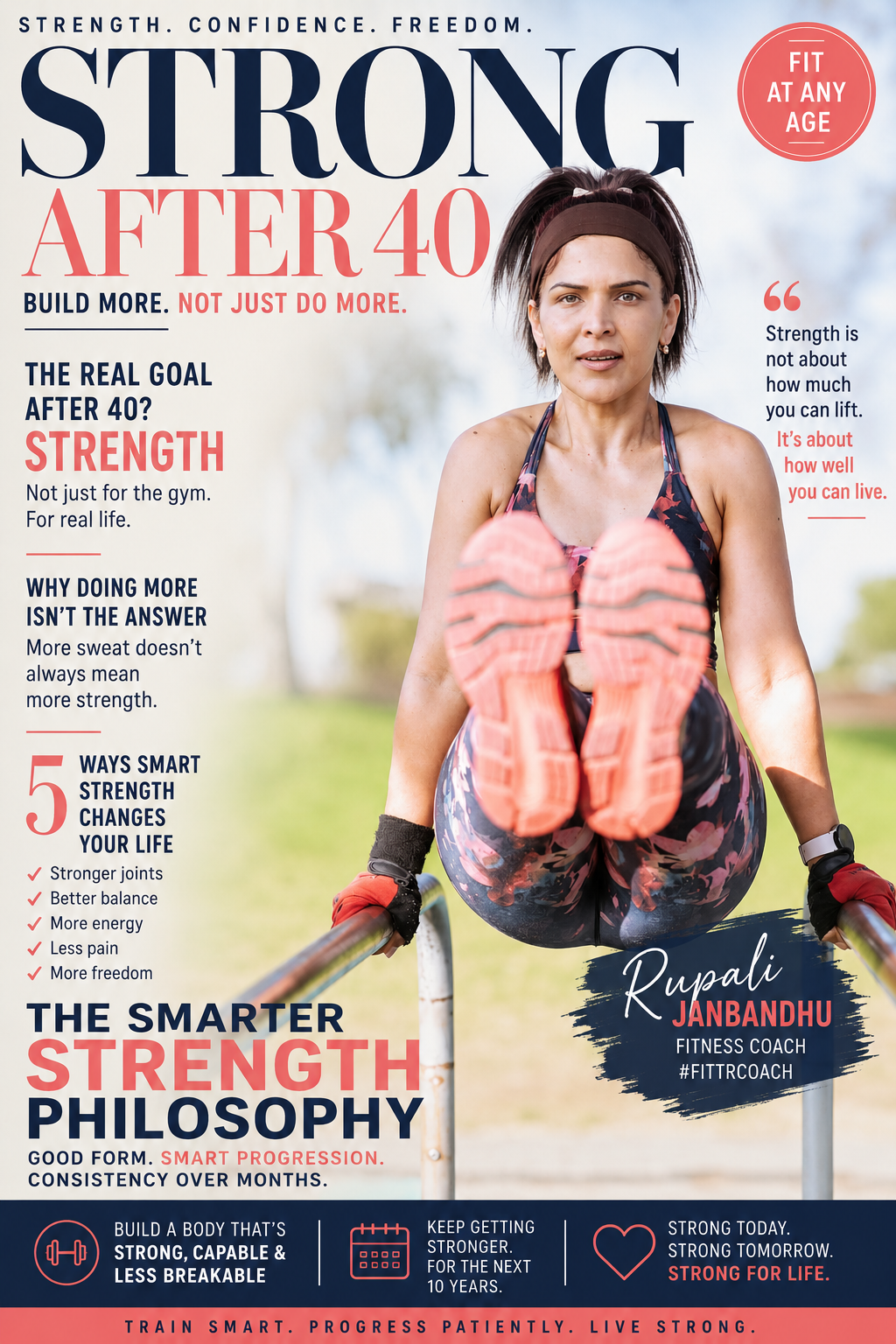
STRONG AFTER 40
The Smarter Strength Philosophy of Rupali Janbandhu
Most People Over 40 Get This Wrong
By Rupali Janbandhu | Fitness Coach | #FITTRCoach
There is a particular kind of fitness advice that becomes louder as we cross 40.
Do more.
Sweat more.
Train harder.
Push until you are exhausted.
Finish every workout feeling like you have nothing left.
It sounds disciplined. It looks impressive. And sometimes, it can even feel incredibly satisfying.
But if the real goal is to build a body that feels strong, capable, resilient and dependable for years to come, Rupali Janbandhu believes there is a better question to ask.
Not:
“How much more can I do?”
But:
“How much stronger can I become—and can I keep doing it safely?”
That distinction changes everything.
The Fitness Shift That Happens After 40
After 40, fitness becomes less about proving how hard you can push yourself and more about understanding what your body actually needs.
The goal isn’t simply to burn calories or chase exhaustion.
It is to build physical capacity.
To become the person who can get down on the floor and stand back up without hesitation. Who can carry grocery bags without feeling it in the lower back. Who can walk, hike, climb stairs or run without constantly negotiating with aching knees.
It is about having shoulders that feel stable, hips that move confidently and a core that supports everyday life.
For Rupali, strength is not just a gym metric. It is independence in motion.
Strength That Shows Up in Real Life
Real strength doesn’t always announce itself with a heavier barbell or a dramatic transformation photograph.
Sometimes it looks much simpler.
It is lifting a suitcase into an overhead compartment.
Carrying your child.
Getting up from a chair with ease.
Walking uphill without feeling defeated.
Maintaining balance when life unexpectedly challenges you.
These are the moments when fitness stops being about appearance and starts becoming about quality of life.
The Problem With the “More Is Better” Mentality
There is nothing inherently wrong with challenging workouts.
The problem begins when intensity becomes the only measure of progress.
A workout that leaves you completely exhausted can certainly feel productive. But exhaustion isn’t the same thing as adaptation.
When training becomes chaotic, relentlessly intense or poorly managed, people often find themselves in one of two situations.
They develop recurring aches and take time off.
Or they continue training, but never create the consistency necessary to actually become stronger.
The result?
A lot of fatigue.
Not necessarily a lot of progress.
Getting Tired Isn’t the Same as Getting Stronger
Strength is built through a repeated signal to the body:
Here is the movement.
Here is the stimulus.
Now adapt.
That requires patience.
It requires technique.
And, perhaps most importantly, it requires progression.
Rupali’s philosophy moves away from the idea that every workout needs to be spectacular.
Instead, it embraces something far more powerful:
Simple training done exceptionally well, repeatedly.
The Boring Formula That Actually Works
Good form.
Smart progression.
Consistency over months and years.
That’s the foundation.
It may not always make the most exciting social-media caption, but it is the kind of approach that can create meaningful, sustainable change.
1. Technique Before Ego
When movement becomes sloppy, the body begins looking for shortcuts.
Those shortcuts can shift stress away from the muscles you intended to train and place it somewhere else.
Good technique isn’t about making exercise look perfect.
It is about teaching your body to move efficiently.
The better the movement pattern, the better the foundation for progression.
2. Progression, Not Randomness
Doing the same workout forever may feel comfortable, but the body eventually needs a new challenge.
That doesn’t necessarily mean dramatically increasing the weight.
Progress can come through:
- More controlled repetitions
- Greater range of motion
- Slower tempo
- Better stability
- Increased resistance
- Improved leverage
- Additional repetitions
- More efficient technique
The principle is simple:
Give the body a clear reason to adapt.
Randomly making every session harder isn’t necessarily progression.
Structured progression is.
3. Consistency Beats Occasional Heroics
One brutally difficult workout followed by several days of recovery isn’t necessarily a winning strategy.
A sustainable program should allow you to train, recover and return.
Again.
And again.
And again.
That is where the magic happens.
Strength isn’t usually built in one extraordinary session.
It is built quietly through hundreds of ordinary sessions.
What “Smart Strength” Looks Like After 40
For Rupali Janbandhu, smart strength isn’t about chasing punishment.
It is about creating a training environment where the body can improve without constantly being pushed beyond its ability to recover.
Choose Key Movements
Rather than constantly jumping between exercises, focus on fundamental movement patterns and become genuinely skilled at them.
Train With Purpose
Every session should have a reason.
Not every workout needs to leave you crawling out of the gym.
Sometimes the most productive session is the one that leaves you feeling better, stronger and ready for the next one.
Make Progress Gradually
Increase the challenge intelligently.
A little more range.
A little more control.
A few more repetitions.
A slightly heavier load.
Small improvements accumulate.
Respect Recovery
Training is the stimulus.
Recovery is where the body gets the opportunity to respond.
Ignoring recovery in the pursuit of more can eventually become counterproductive.
The Unexpected Benefit: You May Lean Out Too
There is an interesting side effect to this approach.
When people stop obsessing over how many calories they can burn in a single workout and start focusing on becoming stronger, they often create the conditions for better long-term body composition.
Why?
Because sustainable training encourages consistency.
Better movement allows people to train more effectively.
Improved strength can increase physical capability.
And adequate recovery makes it easier to keep showing up.
The result isn’t necessarily dramatic overnight transformation.
It is something more valuable:
A body that becomes increasingly capable of doing the work.
After 40, Change the Question
Perhaps the biggest shift isn’t physical at all.
It is psychological.
For years, fitness culture has encouraged people to ask:
“How much can I endure?”
Rupali Janbandhu proposes a different question:
“How much stronger can I become while keeping my body capable for the next decade?”
That is a very different definition of fitness.
It doesn’t glorify exhaustion.
It doesn’t confuse pain with progress.
It doesn’t demand perfection.
It asks for something much more sustainable:
Train intelligently. Progress patiently. Recover properly. Keep going.
The Decade-Long Perspective
Imagine approaching your 40s, 50s and beyond not by trying to preserve the body you had at 25, but by building a body that is more capable for the life you actually live today.
That means strength that supports independence.
Mobility that supports movement.
Fitness that supports confidence.
And training that fits into real life rather than taking over it.
The objective isn’t to become younger.
It is to become stronger, more capable and harder to break down with time.
Rupali Janbandhu’s Strength Philosophy
Don’t Chase Exhaustion. Chase Adaptation.
Don’t Measure Fitness Only by Sweat. Measure It by Capability.
Don’t Train Randomly. Progress With Purpose.
Don’t Look for Shortcuts. Build Skills.
Don’t Aim for a Perfect Week. Build a Sustainable Practice.
And above all:
Don’t ask how much more you can do.
Ask how much better you can become.
The Stronger-For-Life Mindset
The most powerful fitness transformation after 40 may not be the one that changes your appearance the fastest.
It may be the one that changes how you experience your own body.
Getting out of bed feels easier.
Stairs feel less intimidating.
A hike becomes enjoyable instead of exhausting.
Your shoulders feel stable.
Your hips feel capable.
Your confidence grows because your body keeps proving that it can do more.
That is the kind of strength Rupali Janbandhu is advocating for.
Not strength for the sake of a number.
Not fitness for the sake of punishment.
But strength as a long-term investment in freedom, confidence and everyday life.
Because the goal isn’t to finish every workout on the floor.
The goal is to keep getting stronger—and still be moving confidently years from now.
Rupali Janbandhu
Fitness Coach | #FITTRCoach
Train smart. Build strength. Stay capable.

