





From Quick Fixes to Lasting Strength
How Sonam Singh turned a struggle with body image into a sustainable fitness philosophy
By Sonam Singh
There was a time when I looked at photographs and my first thought was not about the moment, the people around me, or the memory being created.
It was about my body.
How do I look? Do I look fat? How can I make sure I don’t look as heavy as I actually am?
That constant self-consciousness became one of the reasons I started my fitness journey. But, like many people looking for a way out of body-image insecurity, I initially searched for the fastest possible solution.
I tried the familiar promises of “7 din mein 10 kilo wajan ghatayein”—the kind of magical diets that sound convincing for seven days but rarely make sense for real life.
By the fifth day, I would feel weak. And once those seven days were over, the restrictions would end too—and I would find myself overeating.
That cycle taught me an important lesson: a plan that cannot be sustained cannot create a sustainable transformation.
The Moment Everything Changed
I eventually understood that I didn’t need another short-term diet.
I needed a way of eating and living that I could continue for years.
That was when transformation stories from FITTR began appearing on my Facebook feed. Around the same time, TC9 was about to begin. I decided to participate—not because I believed a competition could magically transform me, but because I thought the accountability and extra push might help me stay committed.
It did.
But the biggest transformation wasn’t simply physical.
It was educational.
I began understanding that eating “healthy” does not necessarily mean surviving on fruits and vegetables while eliminating rice or wheat. Food doesn’t have to be divided into good and bad. What matters is understanding your body’s requirements and learning how different foods can fit into your overall nutrition.
For the first time, I wasn’t trying to eat as little as possible.
I was learning how to eat intelligently.
I Didn’t Have to Give Up Everything I Loved
One of the biggest shifts in my mindset was learning about macros and nutritional requirements.
I could eat the foods I enjoyed while making sure they fitted into my nutritional goals.
That simple realisation made fitness feel less like punishment and more like something I could actually live with.
There was no need for extreme restriction.
No need to fear rice.
No need to eliminate wheat simply because someone on the internet said so.
And no need to spend my life moving from one “7-day miracle diet” to another.
I was finally building something designed for the long term.
Progress Became the Goal—Not Perfection
With this approach, I managed to finish among the Top 200 in TC9 and TC10.
But those achievements were only part of the story.
What mattered more was the way I approached the journey.
I started on January 1, 2020, with a simple intention: become a fitter version of myself by December 2020.
Instead of demanding an overnight transformation, I created milestones.
I gave myself time.
And when I reached my initial goal earlier than expected, I didn’t stop. I added another challenge—to become a FITTR coach by December 2020.
I am grateful that I was able to achieve both goals.
That experience changed the way I viewed transformation itself.
Fitness Is Not a Deadline
The fitness industry often makes transformation look like a finish line.
Lose a certain number of kilos.
Fit into a certain size.
Get visible abs.
Transform in 30 days.
But our bodies don’t work according to marketing deadlines.
Real transformation is a process of learning, adapting, repeating and becoming better.
I often think of the body as a piece of clay.
You cannot mould it into the shape you want by forcing it overnight. You work on it patiently, consistently and deliberately.
You shape it over time.
That is how sustainable fitness works too.
Our body isn’t a line of Java code that can simply be clicked, executed and expected to produce an immediate result.
It needs patience, consistency and work.
From Transforming Myself to Helping Others
My journey eventually led me towards becoming a coach.
Today, one of the things I value most is helping my mentees understand what I have learned through my own experience:
Consistently moving towards a sustainable goal is far more powerful than chasing a quick fix.
I know what it feels like to look for shortcuts.
I know what it feels like to start an extreme diet with enthusiasm and abandon it a few days later.
And I know the difference between temporarily changing your weight and genuinely changing your relationship with food, movement and your own body.
That experience shapes the way I coach.
I don’t want people to simply complete a diet.
I want them to understand why they are eating the way they are eating.
I don’t want them to depend on motivation forever.
I want them to build habits they can maintain when motivation disappears.
And I don’t want fitness to become another source of insecurity.
I want it to become a source of confidence.
The Real Transformation
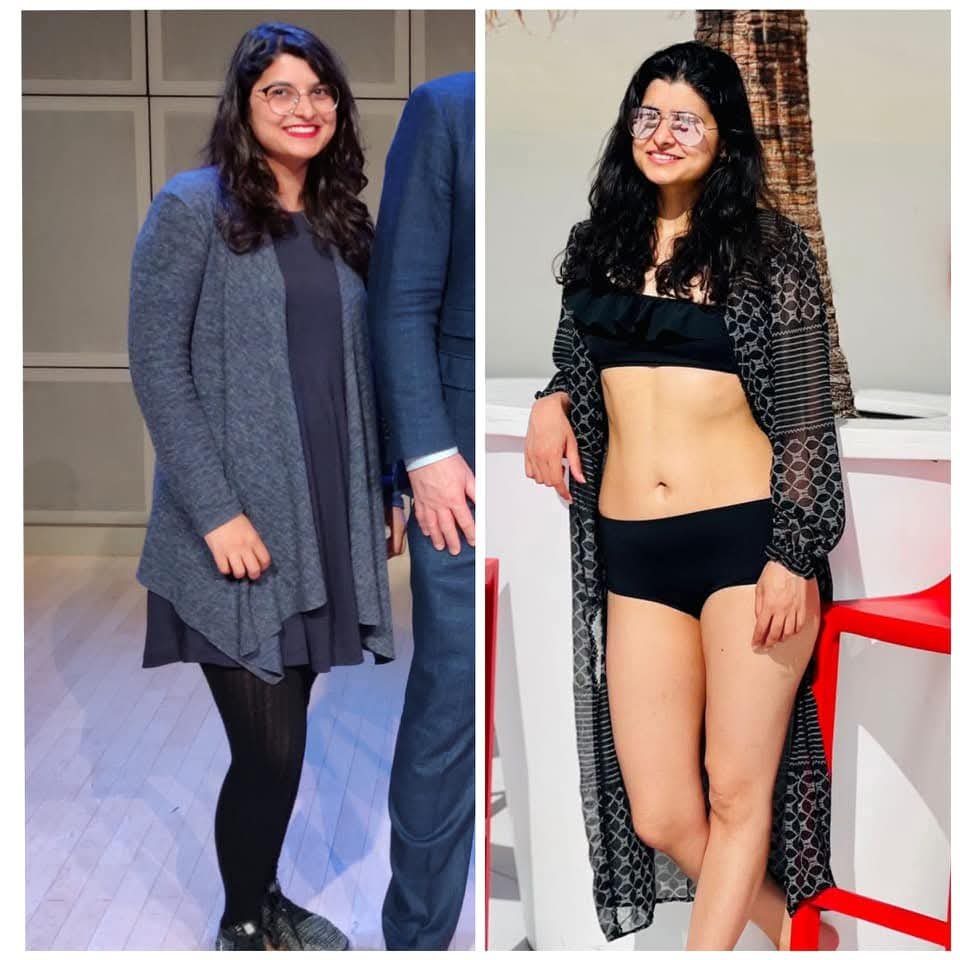
Looking at the before-and-after photographs, the physical change is obvious.
But for me, the more meaningful transformation happened internally.
The woman who once worried about how she looked in photographs learned to understand her body rather than constantly criticise it.
The woman who once searched for seven-day solutions learned to think in terms of months and years.
And the person who once needed guidance eventually found herself in a position to guide others.
That, to me, is what transformation really means.
Not becoming perfect.
Not becoming someone else.
Becoming a stronger, more informed and more confident version of yourself.
Sonam Singh’s Fitness Philosophy
1. Choose sustainability over speed
A slower approach that you can maintain will always beat an extreme approach that you abandon.
2. Stop fearing food
Rice, wheat, fruits, vegetables and other foods can all have a place in a balanced diet when they fit your nutritional requirements.
3. Set milestones, not impossible deadlines
A long-term goal becomes easier when you break it into realistic, measurable steps.
4. Learn instead of blindly following
Understanding nutrition and your body’s requirements gives you independence.
5. Consistency beats intensity
You don’t need to destroy yourself in every workout. You need to keep moving forward.
A Journey That Became a Purpose
I began my fitness journey because I was tired of feeling insecure.
I continued because I discovered that fitness could be sustainable.
And eventually, I became a coach because I realised that what I had learned could help someone else avoid the same cycle of restriction, frustration and guilt.
My journey began with wanting to change how I looked in photographs.
It became something much bigger.
It became a lesson in patience, discipline, education and self-belief.
And if there is one message I would want someone beginning their own journey to remember, it is this:
Don’t look for the fastest way to change your body. Look for a way of living that you can continue long after the transformation photographs are taken.
Because lasting change isn’t about finding a shortcut.
KARNE SE HOGA.
About the Author
Sonam Singh is a fitness coach who believes in sustainable nutrition, consistency and practical fitness rather than extreme short-term solutions. Her own transformation journey—from struggling with body-image insecurity and restrictive diets to becoming a coach—shapes her approach to helping others build healthier, more sustainable lifestyles.
#FittrCoach #BasicToStandard #KarneSeHoga #Transformation #SustainableFitness #FitnessJourney #WomenWhoLift #HealthyLifestyle #Consistency #Nutrition #BodyTransformation

