





THE WEIGHT OF CONFIDENCE
Why lifting weights doesn’t make women masculine—it makes them stronger, sharper and unapologetically themselves
By Kritika Kaur
There is a sentence almost every Indian girl has heard at some point:
“Weight mat utha, ladko jaisi ho jayegi.”
Don’t lift weights. You’ll start looking like a boy.
It is usually delivered as advice. Sometimes as concern. Often as an unquestioned rule passed down from one generation to another.
But here is the irony: while girls are being warned away from the weights section, countless men have been spending years in gyms, eating carefully planned meals, chasing muscle gain—and still struggling to achieve the “bulky” physique everyone seems so afraid of.
And somehow, we are expected to believe that a woman picking up a 7.5-kilogram dumbbell will wake up the next morning looking like a professional bodybuilder.
Reality has other plans.
The Myth of the “Bulky Woman”
Muscle doesn’t happen overnight
Building significant muscle is not an accidental side effect of walking into a gym.
It requires consistent resistance training, progressive overload, adequate nutrition, recovery, genetics and time.
For most women, strength training is far more likely to create a body that looks strong, athletic and defined than an excessively muscular one.
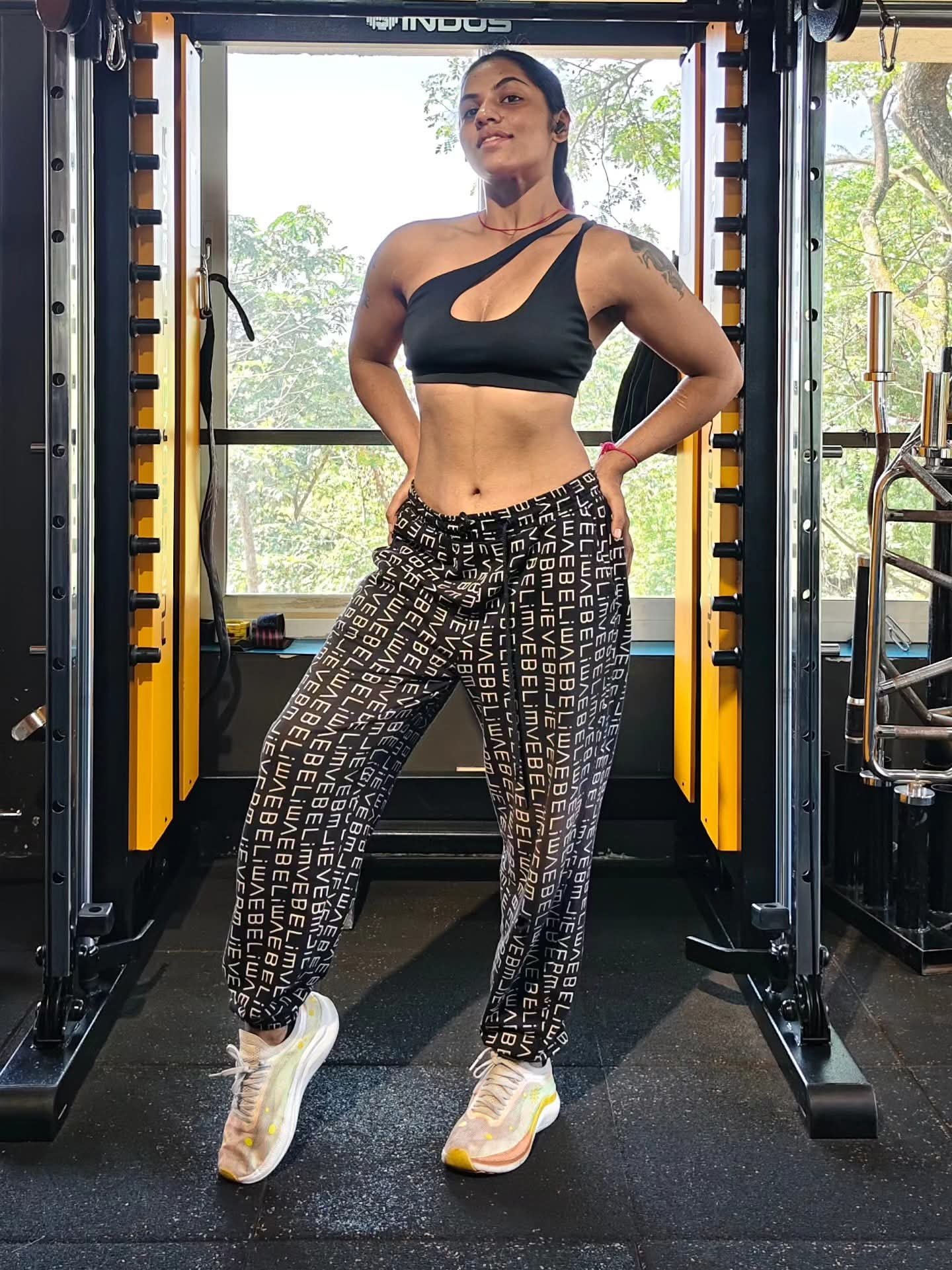
The body in these photographs tells that story beautifully.
On one side, Kritika stands in workout clothes—sports bra, shorts, sneakers, messy bun—with her shoulders, arms and legs visibly trained.
On the other, she is dressed for an evening out in a flowing red outfit and heels.
Different clothes. Different setting. Different mood.
The same woman. The same body. The same muscle.
And that is precisely the point.
From the Gym Floor to the Evening Dress
The body doesn’t become masculine. The perception changes.
In the gym, muscles are often interpreted through the language of performance.
Strength. Power. Athleticism. Discipline.
Outside the gym, those very same muscles can become something else entirely.
Elegance.
Structure.
Posture.
Confidence.
A defined shoulder beneath a sports bra looks athletic.
The same shoulder beneath an elegant blouse or dress can create a completely different silhouette.
The muscle hasn’t changed.
The context has.
This is one of the most fascinating things about strength training: it doesn’t force women to choose between being strong and being feminine.
It allows them to define femininity on their own terms.
What Lifting Actually Changes
1. Stronger arms—not “manly” arms
Many women begin resistance training because they want their arms to look more defined.
What they discover is that definition isn’t created by avoiding muscle.
It is created by having muscle.
As body composition changes and muscle develops, the arms can appear firmer and more sculpted.
That sleeveless outfit you once avoided?
You may eventually wear it without thinking twice.
2. Better-fitting clothes
Strength training can change the way clothing sits on the body.
A stronger back, developed shoulders and improved posture can influence how blouses, dresses, sarees and fitted outfits look and feel.
It isn’t necessarily about becoming smaller.
Sometimes, it’s about becoming better proportioned, stronger and more comfortable in your own skin.
3. A stronger posture
There is something unmistakable about the way a woman carries herself when she becomes physically stronger.
The shoulders are more stable.
The back is stronger.
The core is better conditioned.
Movement becomes more controlled.
And confidence often follows.
Not because a number on the weighing scale suddenly changed—but because the person standing in front of the mirror feels capable.
“Toned” Is Not a Different Kind of Human Tissue
The fitness industry sometimes makes this unnecessarily complicated
Women frequently say:
“I don’t want to build muscle. I just want to get toned.”
But what does “toned” actually mean?
In practical fitness language, that appearance generally comes from having sufficient muscle combined with an appropriate level of body fat.
So the physique many women save on Pinterest—the defined shoulders, firm arms, athletic legs and sculpted back—is not the result of avoiding muscle.
That look is muscle.
The very thing women are sometimes encouraged to fear is often the thing they are trying to achieve.
The Pink-Dumbbell Trap
Light weights have their place. But they shouldn’t become a limitation.
There is absolutely nothing wrong with starting with light dumbbells.
In fact, beginners should learn movement patterns, technique and control before aggressively increasing loads.
But there comes a point when the body adapts.
If the same weight feels effortless forever, the training stimulus eventually becomes insufficient for continued progress.
That is where progressive overload matters.
It doesn’t mean lifting recklessly.
It means gradually challenging the body through changes in weight, repetitions, sets, range of motion, tempo or training difficulty.
The goal isn’t to prove something to the boys in the gym.
The goal is to become stronger than the woman you were yesterday.
The Weight Section Doesn’t Belong to Men
Take your place
Walk into almost any gym and you’ll find an invisible social map.
Cardio machines.
Stretching areas.
Machines.
And somewhere in the middle or at the back—the weights.
For generations, women have been subtly encouraged to stay on the treadmill, perform endless cardio or choose the lightest possible equipment.
But the squat rack doesn’t have a gender.
Neither does the barbell.
Neither does the dumbbell.
Strength is not masculine. Strength is human.
Women deserve access to resistance training just as much as men do.
Strength Beyond the Mirror
This isn’t only about looking good
The most important transformation may not be visible in a photograph.
Strength training can become a lesson in patience.
You learn that progress takes time.
You learn that technique matters.
You learn that consistency beats motivation.
You learn that failure doesn’t mean you’re incapable—it often means you’re being challenged.
And eventually, you begin carrying that mindset beyond the gym.
Into your career.
Your relationships.
Your ambitions.
Your everyday life.
The dumbbell becomes more than a piece of equipment.
It becomes evidence that you are capable of doing difficult things.
From Hiding to Owning the Space
There is a particularly powerful transformation that happens when a woman stops dressing to hide her body and starts dressing to express herself.
Maybe it is the sleeveless top she once avoided.
Maybe it is the saree blouse she finally wears confidently.
Maybe it is the dress that shows her shoulders.
Maybe it is simply walking into a room without wondering whether everyone is judging her body.
The objective of fitness isn’t to make every woman look the same.
It is to help women feel at home in their own bodies.
And sometimes, that journey begins with something as simple as picking up a heavier dumbbell.
Strong Is a Look. But More Importantly, Strong Is a Feeling.
The real transformation
Kritika’s two photographs offer a powerful visual contradiction to an outdated idea.
In one, she is visibly training.
In the other, she is dressed for elegance.
Neither version cancels the other.
The woman lifting weights is not less feminine.
The woman in red is not less strong.
They are the same woman.
And perhaps that is the message worth carrying forward:
You don’t have to choose between strength and femininity.
You don’t have to choose between muscles and elegance.
You don’t have to choose between athleticism and beauty.
You can build strength in the morning and dress up beautifully in the evening.
You can love your muscles and your sarees.
You can lift heavy and still love pink.
You can be powerful without becoming someone else.
So, Dear Desi Girl… Pick Up the Weights.
The boys don’t own the weights section.
Your femininity isn’t sitting inside a dumbbell waiting to disappear.
And no, your 7.5-kilogram dumbbell isn’t going to transform you into a bodybuilder overnight.
Start where you are.
Learn the movements.
Lift safely.
Progress gradually.
Eat well.
Recover properly.
And give your body time to adapt.
Because the goal was never to become “bulky.”
The goal was to become strong enough that you no longer feel the need to hide.
And if you know a girl who still thinks lifting weights will make her “look like a man,” send this to her.
She doesn’t need permission to enter the weights section.
She belongs there.